


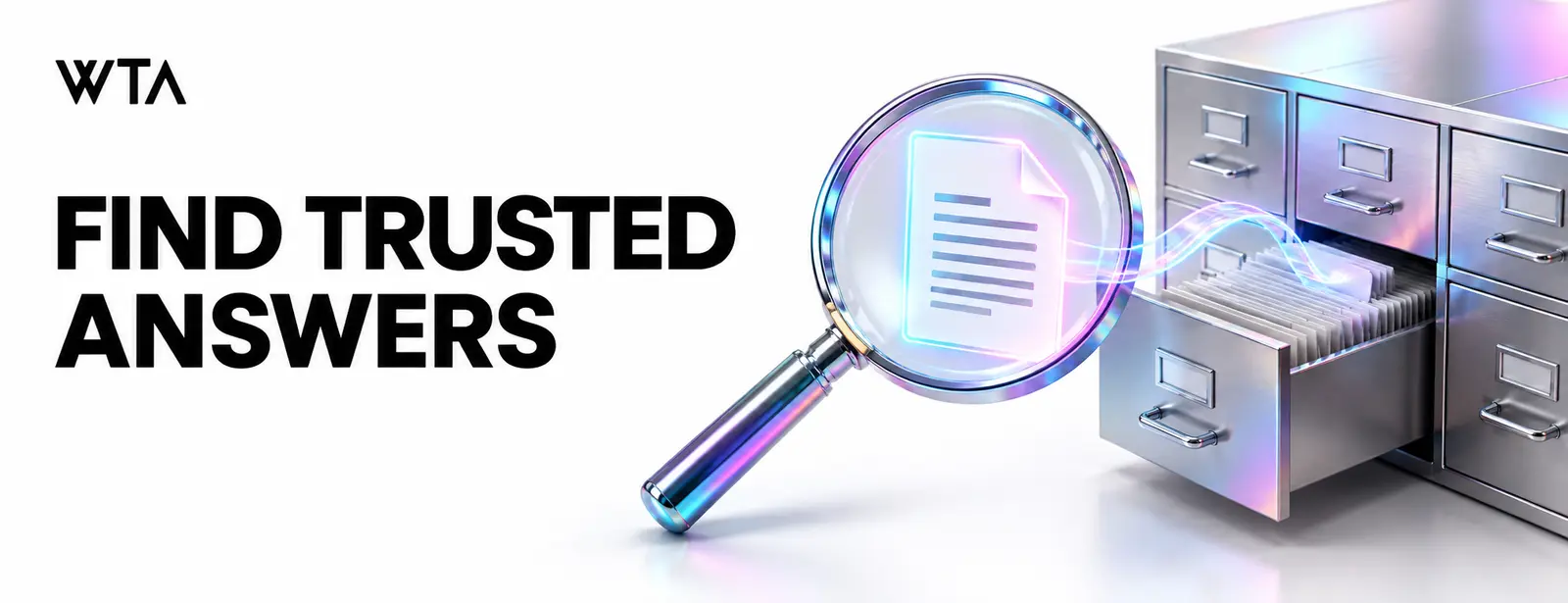
What does retrieval add to AI answers?
Retrieval-augmented generation gives a model relevant source material when answering a question. For enterprise teams, that may include approved procedures, product records, or support information. The goal is a useful answer supported by accessible evidence. Retrieval does not guarantee correctness; the answer and its cited sources still need evaluation.
Identify who may view each record and enforce that permission when retrieving information. Do not assume a shared search index should expose everything to every user. Check document versions, ownership, retention rules, and restricted fields. Source access changes must reach the search layer so withdrawn permissions do not leave information available through older copies.
Different questions need different update intervals. A policy library may tolerate scheduled updates, while operational records may need faster synchronization. Define what current means for the workflow and show timestamps where useful. Test updates, deletions, failures, and unavailable sources. Keep the system honest when it cannot retrieve sufficiently current information.
Evaluate answers and retrieval separately
Check whether the system finds the right material before judging the generated response. Test missing documents, ambiguous questions, conflicting versions, and unsupported requests. Start with a simpler retrieval approach and add relationship-based techniques only when the use case and evaluation justify the extra complexity. More infrastructure does not automatically mean better answers.
Choose a limited source and a representative question set. Ask users whether the answer, source links, and limitations help them complete their task. Track accuracy, retrieval failures, access errors, response time, and operating cost. Improve the source material as well as the application before extending the solution.
Start with the questions employees cannot answer easily
Collect examples from the people who search the existing systems every day. Ask what they were trying to accomplish, which terms they used, and why the result was inadequate. Separate missing information from difficult navigation and unsuitable access. Those problems need different remedies; adding a generated summary will not recover a document that was never recorded.
For an illustrative operations team, the task might be finding the current procedure for an unusual customer request. Include the customer's context and the employee's role in the assessment. A generally relevant document may still be wrong for that situation. Define what an acceptable answer must establish and which source should be treated as authoritative when records disagree.
Give sources a maintained business identity
Assign owners to important information sets and record how changes become available to the application. Identify obsolete documents and duplicated guidance before widening use. Employees should be able to distinguish an approved procedure from a historical example. Preserve useful context such as effective dates and the business area to which a document applies.
Test information removal as well as addition. If a source becomes restricted or is withdrawn, the search experience should reflect that change through its supported update process. WTA's platform modernization services address these integration dependencies. Our AI-native product engineering services connect retrieval to a user experience that makes source evidence and uncertainty understandable.
Evaluate retrieval separately from the generated answer
First inspect whether the application found the information needed to answer the question. Then assess whether the response represented that information accurately. Keeping these checks separate helps diagnose failures. Improving a prompt is unlikely to solve a missing-source problem, while retrieving the right document does not guarantee that the summary preserves its qualifications.
Maintain examples with similar terminology, conflicting versions, and no valid answer. Ask domain owners to review the expected outcome. Evaluate supporting links by opening them and confirming that they substantiate the claim. A citation that merely points to a related document can create misplaced confidence even when the answer sounds reasonable.
Make the support experience part of the design
Let employees flag an outdated source, challenge an answer, or reach the person responsible for the process. Capture enough context to investigate without collecting unnecessary sensitive content. Route information-quality issues to the source owner and application failures to the technical team. A single undifferentiated feedback queue can leave both kinds of issue unresolved.
Review the complete task after launch. Measure accepted answers, correction effort, repeated searches, and support demand. Watch for users treating a generated response as authority beyond the source material. Expand to new information sets only after establishing ownership, access expectations, and evaluation examples for them. A successful connection to one repository does not establish readiness for every system in the enterprise.
Frequently asked questions
Does enterprise search require replacing legacy systems?
Not always. A useful service may connect to approved information through supported interfaces while the original system remains authoritative. Assess access, update behavior, and maintenance effort before choosing the design. Where the source cannot provide dependable information, improving that foundation may be more valuable than adding a new search interface.
What should happen when sources disagree?
The application should preserve the conflict and use an agreed rule for authoritative sources where one exists. If the evidence remains insufficient, ask for clarification or refer the employee to the responsible owner. Generating a single confident conclusion from contradictory material can hide the very issue the user needs to understand.
Are citations enough to prove an answer is correct?
No. Check whether the cited material actually supports the answer, is current, and applies to the user's situation. A relevant link may still omit an important qualification. Evaluate both source retrieval and the generated response so the team can distinguish information problems from errors introduced during summarization.
How should success be assessed?
Compare employees' ability to complete the intended task with the previous process. Measure accepted answers, review effort, repeated attempts, and escalation quality. Include questions with no valid answer. A search service should help people find dependable information and recognize uncertainty, rather than merely return a fluent response to every request.
Updated September 18, 2026. Microsoft RAG design and evaluation guide. Related: Adding AI Agents to Legacy Systems Safely.

.svg)
.svg)
.svg)
.svg)
.svg)
.png)


















.svg)

.png)