


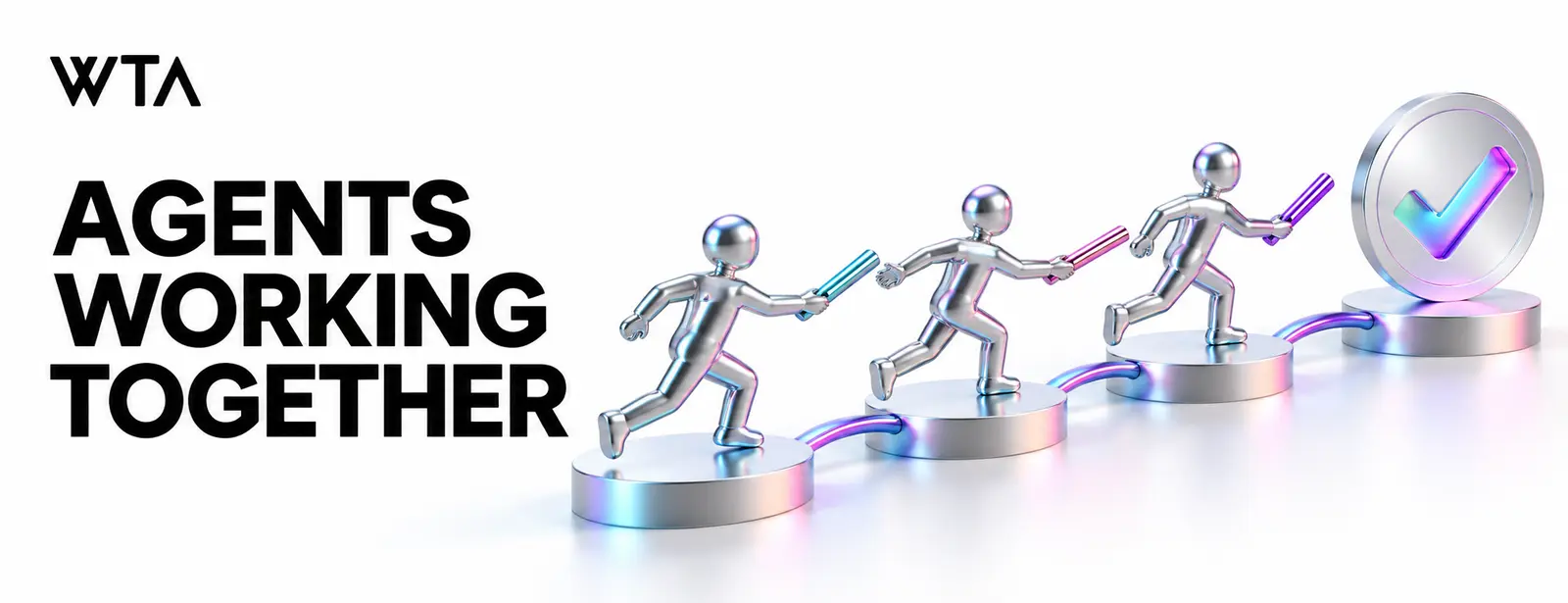
What should an enterprise agent control plane do?
An agent control plane should help an organization understand what its agents are doing, who owns them, what they cost, and when people must intervene. It connects technical observations to business tasks. Its value lies in supporting operating decisions, rather than simply presenting a large number of successful model calls on a dashboard.
For WTA's Agent Swarm engagements, this article describes the operating requirements to agree and verify for each deployment. It is not a universal feature or performance guarantee. The implemented controls, integrations, and support responsibilities must be demonstrated against the customer's scope before the service is accepted for production use.
Start with an inventory of accountable workflows
Record each workflow's purpose, business owner, users, permitted actions, information sources, and deployed version. Connect agents to the tasks they serve rather than listing them as isolated technical components. A support team should be able to answer which business process is affected when a particular integration or model becomes unavailable.
WTA's AI delivery pods and agentic platforms provide the relevant delivery context. AI strategy and governance helps define the responsibilities and acceptance requirements. The inventory should include a retirement or suspension process so unused or unsuitable workflows do not remain connected indefinitely without someone accountable for their access and operating cost.
Make Azure deployment boundaries explicit
List the identities, systems, and information involved in each action. Review the actual application's access, network configuration, secrets handling, and diagnostic records with the responsible teams. An Azure deployment can support an enterprise operating model, but selecting the platform does not by itself establish that the complete application is appropriately configured.
Use Microsoft's Azure security design principles as a technical reference while assessing the specific workload. Define what employees, administrators, and service identities may do. Verify the chosen services and regions against the engagement's requirements, and test the boundaries with representative roles instead of relying only on an administrator's successful demonstration.
Connect monitoring to the business task
Track the path from the user's request through important steps to the actual outcome. Distinguish prepared work, pending approval, completed actions, and uncertain results. A healthy model endpoint does not establish that a purchase request reached its destination or that a generated brief met the business requirement. Operating visibility must include those task-level questions.
Azure Monitor Application Insights supports OpenTelemetry-based collection for supported application environments. The implementation still needs to decide which events and measures are useful. Collect enough information to investigate failures while protecting sensitive content. Avoid treating full conversation logging as the default answer to every diagnostic need.
Review cost and quality together
Measure resources consumed per accepted task, including failed attempts and human correction. Attribute relevant usage to the workflow so owners can understand changes after adding users or capabilities. Compare cost with the quality of completed work. A cheaper run that requires a person to redo the task is not necessarily an improvement in operating economics.
Keep evaluation results connected to the deployed configuration. Recheck representative cases after changes to models, instructions, sources, or tools. Review ordinary failures alongside unusual incidents. Recurring corrections can reveal a source-quality problem or a weak task boundary that will not be solved by increasing the number of agents or adding another dashboard.
Design intervention before it is needed
Agree who may pause a workflow, withdraw an action, or direct work to a person. Specify the information they need and the business process that continues during the interruption. A visible control is useful only if it acts on the actual workflow and the responsible team understands its effect on tasks already in progress.
Rehearse partial completion. If one operation succeeds and another fails, support must identify what happened before retrying. Preserve useful record references and prevent duplicate consequential actions through the application's supported controls. Distinguish a quality reviewer from an authorized approver; a second agent's favorable opinion should not silently grant permission to change a business record.
Establish a practical operating review
Bring the business owner and support team together to review accepted outcomes, unresolved tasks, incidents, correction effort, and cost. Use the findings to prioritize changes. Record the decision behind each expansion of audience or authority. This keeps the control plane connected to the service's purpose rather than becoming a reporting layer that nobody uses to make decisions.
Organizations can contact WTA to assess a workflow and define its deployment and operating requirements. The assessment should establish which controls already exist, which need implementation, and which claims require demonstration. A useful Agent Swarm operating approach gives people clear ownership and evidence, with capabilities validated for the specific engagement before broader adoption.
Frequently asked questions
Is a control plane the same as an agent framework?
No. A framework provides building blocks for application behavior, while a control plane concerns visibility and management across deployed workflows. Their responsibilities can overlap, but the operating design should explain how they connect. Neither label alone establishes that the service has appropriate permissions, evaluation, support, or business accountability.
Does monitoring prove that an agent's answers are correct?
No. Monitoring can reveal operational behavior, but answer and task quality need explicit evaluation. A technically successful request may produce an incomplete or misleading result. Connect operating signals to representative quality checks and user feedback so the team can distinguish service availability from acceptable business performance.
Does using Azure guarantee a secure deployment?
No. Security depends on the application's configuration, identities, access boundaries, data handling, and operating practices. Review and test the actual implementation against the customer's requirements. Platform capabilities are part of the design, while the organization and delivery team remain responsible for the decisions made around the specific workload.
What should be demonstrated before acceptance?
Demonstrate task visibility, permission boundaries, evaluation evidence, cost attribution, and the agreed intervention and recovery procedures. Confirm who owns each responsibility after handover. The exact capabilities depend on the engagement, so acceptance should reference tested behavior rather than assumptions about what a control-plane product name implies.

.svg)
.svg)
.svg)
.svg)
.svg)
.png)
















.svg)

.png)