


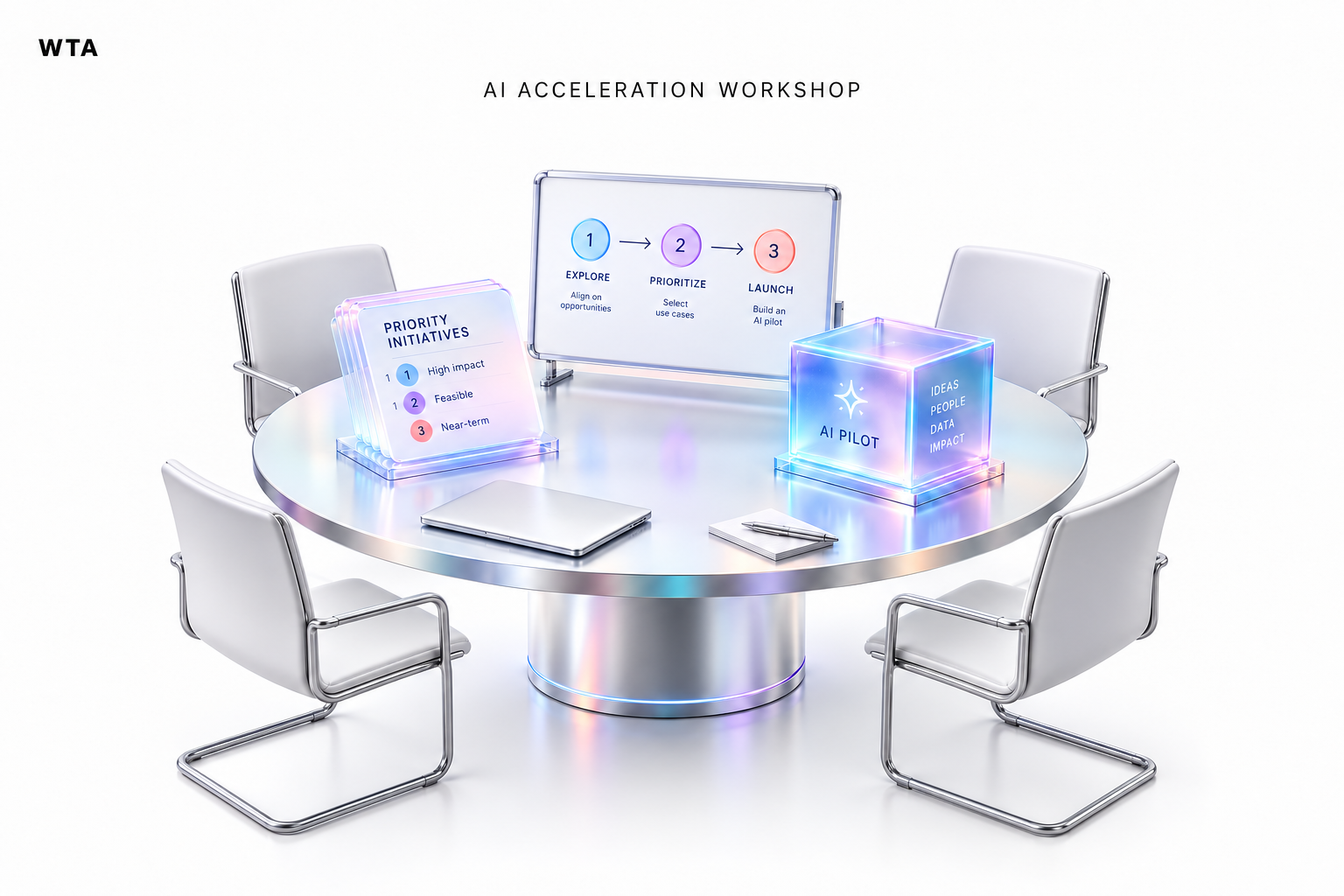
What should an AI workshop produce?
A useful workshop should clarify which problem deserves attention, what success would mean, and what evidence is needed before a pilot. It can also reveal that a process change or conventional automation is the better option. Agree on the scope, participants, and expected outputs with the delivery team before the session.
Include a business owner, someone who performs the task, and representatives from technology, security, and operations where relevant. Finance or procurement may help clarify commercial constraints. A small group with decision-making authority is often more useful than a large audience that cannot resolve practical questions.
Prepare representative examples
Bring a simple workflow map, current volumes, completion times, common errors, and difficult cases. Use approved or anonymized examples when information is sensitive. Identify the systems involved and who controls access. List existing initiatives so the proposed pilot does not duplicate work or depend on changes that have not been agreed.
Ask questions that change the decision
Which user problem are we solving? Why is AI appropriate? What data is available? Which actions need approval? How will quality be tested? What happens when the system fails? Who will support it? What will it cost to operate? How will value be measured? What would make us stop the pilot?
Record the shortlisted use case, assumptions, owners, dependencies, and decision criteria. Separate confirmed facts from questions requiring investigation. Define a limited pilot with measurable acceptance thresholds and a review date. Confirm any commercial terms directly rather than assuming that workshop participation guarantees a delivery commitment. Write down unresolved questions and assign an owner so the session leads to evidence gathering, rather than another discussion.
Bring one real workflow to the discussion
Choose a recurring task and gather a few representative examples of how it begins and ends. Include an ordinary case and an exception that required extra effort. Ask the people who perform the work to describe the handoffs, systems, and decisions involved. A broad ambition such as transforming operations is easier to assess when grounded in an actual journey.
Bring a process sketch if one exists, but allow participants to challenge it. Informal spreadsheets, email approvals, and repeated corrections often explain the real cost. Separate active work from waiting. If the largest delay is an unavailable decision-maker, speeding up a drafting step may not improve the outcome. The workshop should expose that distinction before recommending an agent.
Prepare enough evidence to compare alternatives
Collect approximate task volume, handling effort, review time, and common reasons for rework. Explain how those figures were obtained and where they remain uncertain. Early estimates are useful when clearly labeled; unsupported precision makes later comparisons harder. Avoid including sensitive records unless they are approved for the assessment and the handling arrangements are understood.
Bring a list of the systems holding authoritative information and the people responsible for access. WTA's AI strategy and governance services use this context to assess readiness and prioritize opportunities. If the problem involves fragmented applications or difficult integration, platform modernization may be a more appropriate starting point than a standalone conversational assistant.
Invite the people who can resolve the important questions
The process owner can explain the intended outcome, frontline employees can describe exceptions, and technology owners can clarify integration constraints. Include information or control specialists where the use case needs their judgment. The aim is not a large meeting; it is sufficient coverage to avoid making important assumptions on behalf of absent teams.
Identify which decisions participants can make during the session and which require follow-up. Assign owners to unresolved questions. A productive workshop can conclude that a candidate needs better data or a simpler process change before AI becomes useful. That is a valuable result if it prevents an expensive pilot built around a problem the technology cannot address.
Leave with a reviewable next step
The output should describe the selected workflow, baseline assumptions, proposed intervention, exclusions, and evidence needed for a decision. Include the intended users, permission boundaries, and an initial view of operating cost. A pilot recommendation should explain what it will prove and what would cause the team to stop or choose another approach.
Agree on the deliverables and commercial scope of any subsequent engagement separately. Do not infer a production commitment from enthusiasm during discovery. Business owners can contact WTA to discuss an initial workflow assessment, bringing the task examples and questions described here. The objective is a clear investment decision and an accountable next step, not a generic presentation that leaves the implementation problem unchanged.
Frequently asked questions
Do we need a complete AI strategy before the workshop?
No. A specific business problem and representative workflow examples are enough to begin a useful discussion. Explain the desired outcome, current constraints, and available evidence. The assessment can identify which strategic questions matter to the first opportunity without requiring the organization to resolve every future AI initiative in advance.
Which records should we prepare?
Prepare approved examples of task inputs, completed outputs, exceptions, and relevant process guidance. Include approximate volume and effort with their assumptions. Avoid bringing unnecessary sensitive data. The assessment should establish what further information is required and how it will be handled before a more detailed investigation begins.
What if the workflow is unsuitable for an agent?
The assessment should explain why and identify better alternatives where possible. Conventional automation, clearer responsibilities, or improved information may address the problem more effectively. A decision not to build an agent can be a successful outcome when it prevents avoidable complexity and directs investment toward the actual operating constraint.
What should happen after the workshop?
Review the findings, resolve material unknowns, and agree on a bounded next step. If a pilot is recommended, define acceptance criteria, responsibilities, and scope before starting. If groundwork is required first, give it an owner and a decision purpose so the assessment becomes an actionable plan rather than an isolated discussion.
Updated September 18, 2026. Related: A Practical Five-Stage Framework for AI Delivery.

.svg)
.svg)
.svg)
.svg)
.svg)
.png)
















.svg)

.png)