



When does a workflow need multiple agents?
Use multiple agents when a task benefits from distinct responsibilities, tools, or review steps that a simpler workflow cannot handle well. Examples include separating research from checking or coordinating work across different systems. Begin with one agent or conventional automation and add complexity only when evaluation shows a meaningful improvement.
Sequential handoffs for dependent work
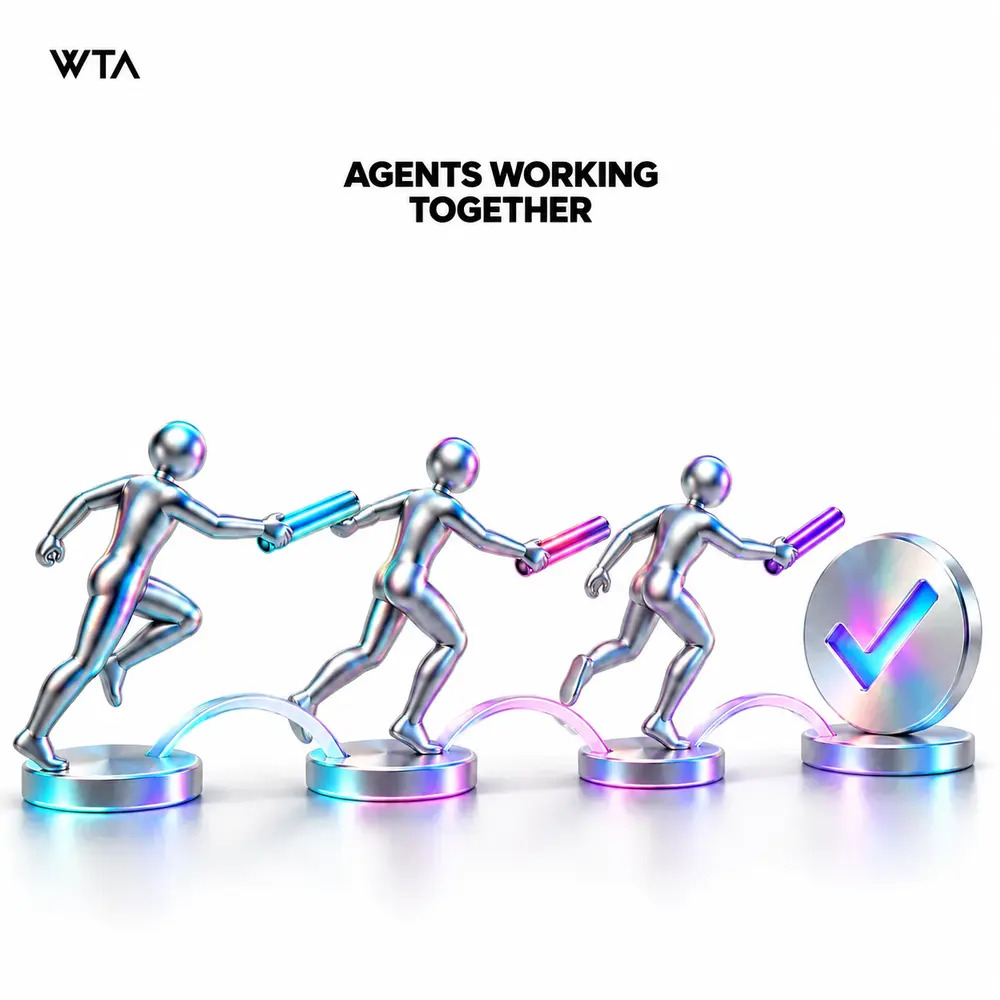
A sequence suits tasks where one step must finish before another starts. For example, gather approved information, draft a response, and send it for review. Define the expected output of each step, validate it before continuing, and specify what happens when information is missing. Keep the handoff narrow enough to inspect and test.
Parallel agents can investigate separate parts of a problem before a final step combines the results. This can reduce waiting time, but it increases coordination and model usage. Set a shared scope and require sources where appropriate. Check conflicting findings instead of treating agreement between agents as proof that an answer is correct.
A coordinator for variable routes
A coordinating agent can select a specialist based on the request. Use a limited set of allowed tasks and tools, with clear rules for delegation. Track the original user intent throughout the workflow. Prevent endless handoffs by setting limits on steps, time, and spending, and define when the coordinator must ask a person for help.
Separate review from permission to act
A second agent can check a draft against defined criteria, but it does not replace authorization. Keep approval for payments, access changes, external communications, or other consequential actions outside the model's discretion. Test whether the reviewer detects realistic mistakes, including unsupported statements and instructions hidden in retrieved documents.
Record task status and completed actions so retries do not create duplicate transactions. Define timeouts, cancellation, and a safe stopping point. Make it possible for support teams to identify which step failed and resume or rerun work safely. Test unavailable services, expired permissions, partial outputs, and interrupted sessions before wider use.
Evaluate the whole workflow
Measure successful task completion, human correction, response time, and cost across the complete chain. Compare the result with a simpler baseline. Review errors at individual steps as well as the final output. A strong agent in isolation can still create an unreliable service when its handoffs or permissions are poorly designed. Make handoff records inspectable.
Map responsibility before choosing coordination
Write the inputs, outputs, and authority of each step in plain language. A procurement workflow might classify a request, gather approved supplier information, prepare a draft, and wait for a person. Some steps can use fixed rules while others need interpretation. Dividing the work this way helps identify where independent agents add value and where ordinary functions are easier to inspect.
Keep the original user request visible across handoffs. A specialist should receive a bounded task rather than freedom to reinterpret the entire objective. Define what it returns and how another component checks that result. Clear contracts between steps make errors easier to isolate and reduce the temptation to treat a persuasive intermediate response as sufficient evidence to continue.
Choose the simplest pattern that survives the exceptions
A sequential route works when the next step is known, while parallel work can help independent investigations. A coordinator is useful when routing depends on the request. Test each design with an ambiguous input and an unavailable dependency. The best demonstration route may be a poor operational choice if it cannot explain what happened after one participant failed.
WTA's agentic platform engineering connects orchestration choices to shared operating needs. AI-native product engineering focuses on the application that users depend on. Neither requires maximizing the number of agents. Compare a proposed design with a simpler baseline and justify additional coordination through clearer responsibility, better quality, or an observable improvement in the business task.
Keep review, approval, and recovery distinct
A reviewer can assess whether an output meets defined criteria, but permission to act comes from the authorized workflow. Keep those decisions separate in the application. Record what was checked, what was approved, and what actually completed. This prevents a favorable model-generated review from being mistaken for authority to send a message or change a record.
Define a stopping condition for repeated attempts. If a step fails its checks, allow only the bounded recovery process agreed for that task, then escalate with useful context. Endless revision can consume resources without improving the answer. Support staff need an understandable task history and an accurate final state, including partial completion, so they can recover work without duplicating successful operations.
Frequently asked questions
Are several agents more reliable than one?
Not automatically. Additional agents create more handoffs and operating complexity as well as opportunities for specialization. Compare designs using the same tasks, quality criteria, and failure cases. Keep extra components when they demonstrate a useful contribution, rather than assuming that agreement among several models establishes the truth of an answer.
When should a workflow use a coordinator?
Use a coordinator when the appropriate route genuinely varies with the request and that choice can be bounded and evaluated. Define permitted destinations and escalation conditions. If the sequence is predictable, explicit routing may be easier to maintain and test than asking an agent to decide the next step each time.
Can a checking agent approve business actions?
Only within an explicitly authorized design; a quality check itself does not grant permission. Keep consequential approvals tied to the responsible person or approved business rule. Record the proposed action and its actual outcome separately from the review so the operating history remains understandable when a problem occurs.
How should repeated failures be handled?
Set limits on attempts, time, and spending appropriate to the task. Preserve the work already completed and explain why the process stopped. Escalate to an authorized person with the relevant evidence. A bounded recovery path is more useful than an open-ended loop that repeatedly produces variations without resolving the underlying problem.
Updated September 18, 2026. Related: Choosing an AI Agent Framework for Enterprise Delivery.

.svg)
.svg)
.svg)
.svg)
.svg)
.png)


















.svg)

.png)